
Short answer
In October 2026 we checked what 20 shilajit products sold to UK shoppers publish about themselves. 11 showed no lab report at all. 7 published heavy metal results from an outside lab, and every published result was within GB limits. 7 product pages made disease or other claims that appear to fall outside UK food rules.
Shilajit is sold in the UK mostly online, by small brands, with little regulatory checking. Lab tests published by researchers have found lead, arsenic and mercury above permitted limits in some samples (Aldakheel et al., 2022), so the one thing a buyer most needs is evidence that their batch has been tested.
We wanted to know how many sellers actually show that evidence. On 23 October 2026 we went through the websites of 20 shilajit products sold to UK consumers and recorded what each one publishes: lab reports, heavy metal results, dose, fulvic acid content, health claims, and the basic information UK rules require.
What did we find?
| Finding | Products |
|---|---|
| Products checked | 20 (15 resins, 4 capsules, 1 gummy) |
| Publish no lab report you can view | 11 |
| Say “lab tested” but show no report | 7 |
| Publish heavy metal figures from an outside lab | 7 |
| Published heavy metal results above GB limits | 0 |
| Make claims that appear to fall outside UK food rules | 7 |
| No “food supplement” wording on the pages we checked | 10 |
| No pregnancy warning on the pages we checked | 8 |
| No business name and address we could find | 10 |
| State the daily amount of shilajit in mg | 16 |
How many sellers publish a lab report?
Fewer than half. Nine of the 20 had a certificate of analysis or lab report you could open. Two more said one was available on request. Seven brands described their product as “lab tested” or “third-party tested” but showed no report anywhere we could find.
Of the nine documents:
- Seven showed figures for all four heavy metals (lead, arsenic, cadmium and mercury) from an outside laboratory, including Eurofins in the UK and India, AGROLAB in Germany and Alex Stewart in Liverpool.
- One showed figures from the seller’s own in-house certificate.
- One reported every metal only as “below the quantification limit”, without figures.
- Three included microbial results (bacteria, yeasts and moulds).
A lab report on a website is not the same as a tested jar. Several reports we saw were for an earlier batch, one was for a bulk sample sent by an overseas supplier rather than a retail jar, and one “current” batch had passed its use-by date on the day we checked. Our guide to reading a certificate of analysis explains what to look for.
Were heavy metals within legal limits?
Every published result was. The GB limits for food supplements are lead 3.0 mg/kg, cadmium 1.0 mg/kg and mercury 0.10 mg/kg (Regulation 1881/2006). The highest published figures were:
| Metal | Highest published result | GB limit |
|---|---|---|
| Lead | 1.01 mg/kg | 3.0 mg/kg |
| Cadmium | 0.13 mg/kg | 1.0 mg/kg |
| Mercury | 0.04 mg/kg | 0.10 mg/kg |
| Arsenic | 2.9 mg/kg | No GB limit for supplements |
Arsenic varied most, from 0.02 to 2.9 mg/kg across the published reports, a roughly 100-fold range. There is no GB arsenic limit for food supplements, so a high result is legal, but it is a reason to prefer products that publish their figures. See heavy metals in shilajit for what these levels mean.
The obvious caveat: sellers choose what to publish. We have no information on the 11 products with no report.
Do the reports match the marketing?
Not always. We noticed several mismatches between what product pages say and what the seller’s own lab report shows:
- One seller says its resin has “zero water weight”, but its lab report shows a dry matter content of 46.6%, meaning roughly half the tested sample was water.
- One seller says its report found “no detectable heavy metals”, but the report lists measurable lead, arsenic and cadmium (all within limits).
- One seller’s batch number and manufacture date differ between the product page and the lab document.
We have not checked any document with the laboratory named on it.
What claims are sellers making?
Seven of the 20 product pages made claims that appear to fall outside UK food rules. Food information can’t claim that a food prevents, treats or cures a disease (Regulation 1169/2011, Article 7), and health claims must be authorised or on the “on hold” list (Regulation 1924/2006). No claim about testosterone is on the list for shilajit. Examples we recorded, quoted from product pages:
- “Helps Manage Fibroids”
- “Boost testosterone levels” and “Reduce stress and anxiety”
- “Naturally increases testosterone levels in men”
- “assists your ability to fight off illnesses effectively”
- “removes heavy metals alongside toxic substances to provide therapeutic benefits to health”
Whether a particular claim breaks the law is for Trading Standards to decide, not us. Our page on shilajit’s UK legal status explains the rules and how to report a product.
What else is missing?
Basic information was often absent from the pages we checked:
- Food supplement wording: 10 of 20 didn’t describe the product as a food supplement. One used US FDA disclaimer text instead.
- Pregnancy warnings: 8 of 20 had none. There is no research on shilajit in pregnancy (see pregnancy and breastfeeding).
- Who is selling it: for 10 of 20 we couldn’t find a business name and UK address.
- Origin: most said only “the Himalayas”. Three named a country.
- Dose: 16 stated a daily amount, ranging from about 100 mg to 800 mg of resin. Two capsule products were extracts that claimed to be “equivalent to” several grams of raw shilajit, which can’t be compared directly. Our dosage guide explains the doses used in research.
- Fulvic acid: where stated, claims ranged from 53% to 87%, usually with no test method given. Fulvic acid results depend heavily on the method, so these figures can’t be compared (see fulvic acid).
What should buyers take from this?
Ask for the report, and check it. A good product page links to a recent, batch-specific certificate from a named independent lab, with figures for all four heavy metals. Treat “lab tested” with no document as untested. Be wary of any seller that says shilajit treats a condition, because that tells you how carefully it follows the other rules. Our buying guide covers the rest, including how to spot fake shilajit.
If you already have a report, our lab report checker compares its heavy metal figures with GB limits.
Can I use these findings?
Yes. You’re welcome to quote the figures or republish the chart below in articles, posts and teaching materials, as long as you credit shilajit.uk with a link to this page. Journalists and researchers can ask for the full dataset, with source URLs, at info@shilajit.uk.
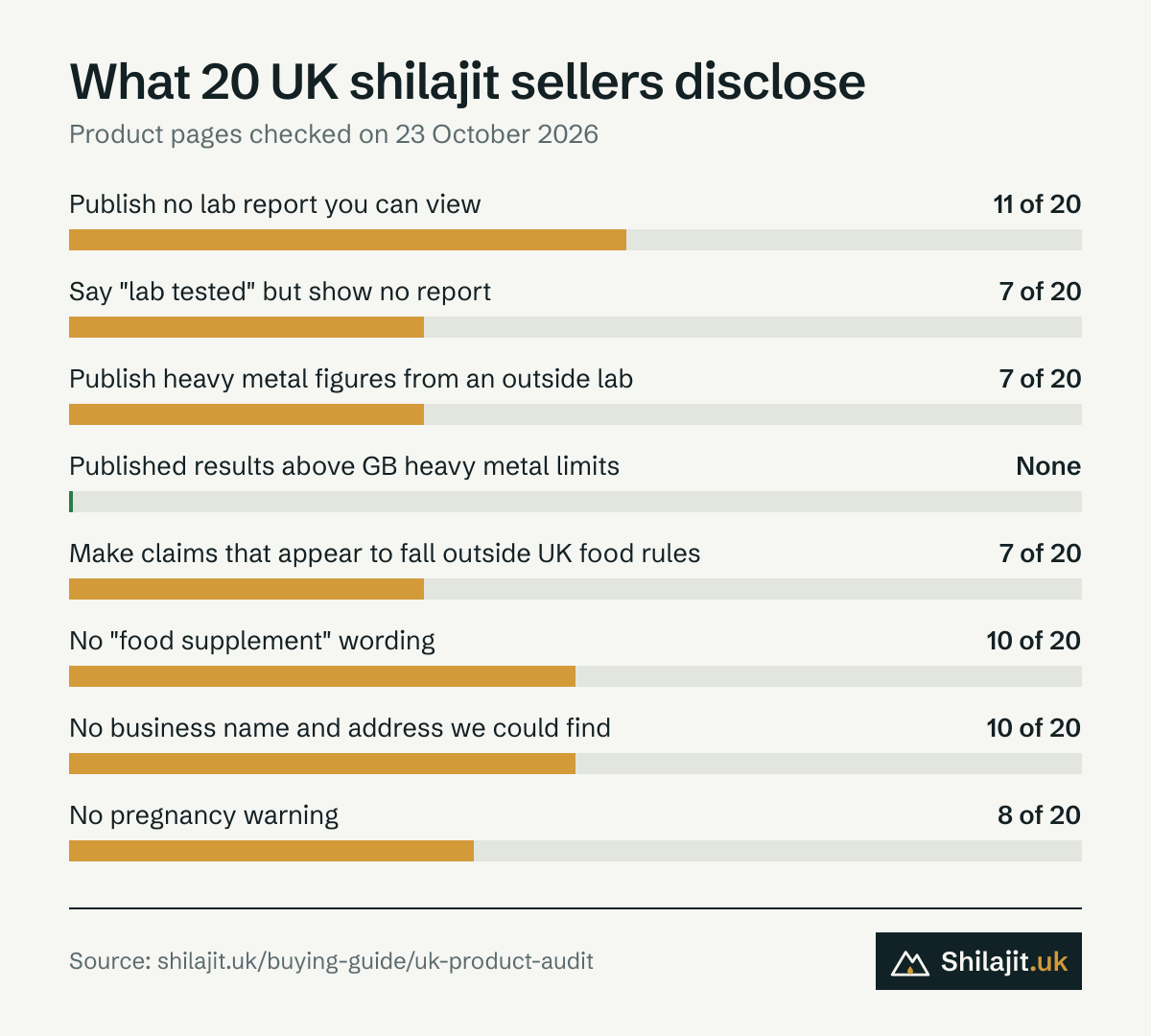
To embed the chart, copy this code:
<a href="https://shilajit.uk/buying-guide/uk-product-audit/"><img src="https://shilajit.uk/charts/uk-shilajit-audit-2026.png" alt="What 20 UK shilajit sellers disclose: UK shilajit audit 2026" width="1200" height="1080"></a>
<p>Source: <a href="https://shilajit.uk/buying-guide/uk-product-audit/">UK shilajit audit 2026, shilajit.uk</a></p>
How we did this audit
- Products: 20 shilajit products sold to UK consumers, one per brand, chosen from UK search results and major UK retailers. The sample leans towards small direct-to-consumer resin brands because they dominate UK search results. It is not a market-share sample.
- Sources: each brand’s own product page, lab-results page and FAQ, accessed on 23 October 2026. Amazon UK and some retailer sites blocked our access, so Amazon listings aren’t included. For one high-street brand we used another UK grocer’s listing of the same product.
- What we recorded: only what was visible. Anything we couldn’t find was recorded as not found. We didn’t contact sellers, buy products or test anything.
- Limits: a missing warning or address on the pages we checked may appear elsewhere on a seller’s site or on the label. Lab documents weren’t verified with the labs.
We plan to repeat this audit, and to commission independent tests of products bought from UK retailers. Sellers who think we have recorded something wrongly can contact info@shilajit.uk, and we’ll correct it. Journalists and researchers can request the full dataset, with the source URL for every data point, from the same address.
Frequently asked questions
How many UK shilajit sellers publish a lab report?
9 of the 20 we checked had a lab document you could view. 7 of those showed figures for lead, arsenic, cadmium and mercury from an outside laboratory. 11 published nothing, including 7 that describe their product as lab tested.
Were any products over the legal limits for heavy metals?
None of the published results exceeded the GB limits for lead (3.0 mg/kg), cadmium (1.0 mg/kg) or mercury (0.10 mg/kg). We can only judge what sellers chose to publish, and 11 of 20 published nothing.
Did you test the products yourselves?
No. This audit records what sellers publish on their own websites. We did not buy or test any product, and we have not verified any lab document with the laboratory named on it.
Why don't you name the brands?
This first edition reports patterns rather than verdicts on individual businesses, because we haven't yet asked each seller to respond. Journalists and researchers can request the full dataset, with sources, from info@shilajit.uk.
References
- Regulation (EC) No 1881/2006 setting maximum levels for certain contaminants in foodstuffs (as retained in Great Britain), Annex.legislation.gov.uk
- Regulation (EC) No 1924/2006 on nutrition and health claims made on foods (as retained in Great Britain).legislation.gov.uk
- Regulation (EU) No 1169/2011 on the provision of food information to consumers (as retained in Great Britain), Article 7.legislation.gov.uk
- Aldakheel RK et al. Rapid Determination and Quantification of Nutritional and Poisonous Metals in Vastly Consumed Ayurvedic Herbal Medicine (Rejuvenator Shilajit) by Humans Using Three Advanced Analytical Techniques. Biol Trace Elem Res. 2022;200(9):4199-4216.pubmed.ncbi.nlm.nih.gov
First published 23 October 2026. Spotted an error? Tell us and we'll correct it. Read our editorial policy.